
Operation P.L.U.S.H
Operation P.L.U.S.H
Utah Games 2026 Capstone Project
-
Toy inspired environment on a giant bed
-
Multiple Characters with unique combat abilities
-
Strategic cooperative gameplay
-
Buildable levels with interactable defenses
-
Combat upgrades to spice up the fight
-
Chaotic and delightful hoard combat
-
Heavy war-torn combat music with a children’s-toy twist
Team Member:
Engineers
Divith Reddy
Raynard Christian
Tianyi Jiang
Mark Xu
Technical Artists
Li-Yu Sun
Jiaqi Han
Alan Liu
Xuanhao Mei
Game Artists
Jaclyn Guido
Wei Zhang
Yichen Lin
Designer
Owen Templeton
Producers
Xiyuan Huang
Matthew Solomon
Sound Team
Dallin Frank - Mixing
Tanner Mahovsky - Sound Design
Malachi Gregory - Composer
Additional Credits
Rachel Buzarde - Animator and Enemy Modeler Lexuan Chen - Prop Modeler
Serina Xu - Lighting
This game supports both PC and Swtich.
Game Link: https://store.steampowered.com/app/4597300/Operation_PLUSH/
Gameplay
Fight the night! Team up with your friends as adorable plushies to defend the Nightlight against creepy, crawly Nightmares. Be brave, little dreamers! Fortify your playspace between rounds using special dream bubbles that contain weapons and power-ups. Beat up the horde of darkness, and play as long as possible to survive the night, or else bedtime is over.
Operation Plush is a 1-4 player horde defender where you take control of dream-powered plushies defending your child's nighlight from the encroaching nightmare horde.
Protect the dream, Defend the nightlight, Defeat the darkness.

Story
The game draws inspiration from a dream shared by one of our team members. In this dream, the quiet, familiar world of childhood—a bed strewn with toys, soft lights, and half-forgotten stories—becomes a fragile battleground against encroaching nightmares. What was once safe and comforting begins to distort, as shadows stretch and ordinary objects take on an unsettling presence.
At its core, the game explores the idea that childhood imagination is not only a source of wonder, but also a form of resilience. The player takes control of beloved toys—small, seemingly powerless figures that come to life with purpose—tasked with defending their world from manifestations of fear. Through playful yet tense encounters, the toys transform into unlikely heroes, using creativity, cooperation, and courage to push back against the darkness.

Plush Style
The game’s visual style is centered around plush toys and the nostalgic memories of childhood. Blending a warm, nostalgic aesthetic with plush-toy softness and subtle horror elements, the experience invites players to revisit the emotional landscape of childhood: where fear feels immense, but so does the power to overcome it.
These are real plush toys for our game. Special thanks to our producer, Matthew.

Rendering
Plush Characters
In this project, I worked as the Character Rendering Technical Artist, responsible for creating the plush fur look for four playable characters.
Since the game is a multiplayer co-op title with latency and performance constraints, I implemented a shell fur solution for the PC version. The fur is generated using a separate skeletal mesh, driven by the character body’s skeleton. This setup also allows the fur layer to be easily disabled for the Switch version to improve performance.
As the project progressed, new requirements continued to emerge from the design team, leading to multiple rounds of iteration and refinement.
There are some iterations:
2025/09/10: I first experimented with a realistic fur solution by generating volumetric textures in Houdini and sampling them in UE5. However, the result felt too realistic for the visual direction of our game, so I explored ways to simplify the fur details and push the look toward a more stylized plush-toy aesthetic.


2025/09/24: I referenced the fur approach used for Menki in Honor of Kings. I used simplified, highly abstract fur textures for sampling and limited the shell layers to fewer than 10. The fur offset was controlled through vertex color to keep the effect lightweight and art-directable.


Because each of the four characters uses a different fabric material, the fur system supports adjustable parameters for fur length, color, material response, and shell layer count.
2025/11/11:To meet the designers’ request for a more stylized lighting style, this new fur shader does not rely on UE5’s built-in fur shading model. Instead, I built a custom lighting approach using Lambert shading combined with banded lighting to achieve a softer, more illustrative character look.
The left version uses PBR lighting, while the right version shows the result after flattening the lighting:


Since the game takes place in a nighttime environment, the characters were difficult to read under physically based lighting. To solve this, I added an adjustable Emissive Color control to reinforce the shadow tone and maintain character visibility in dark scenes.
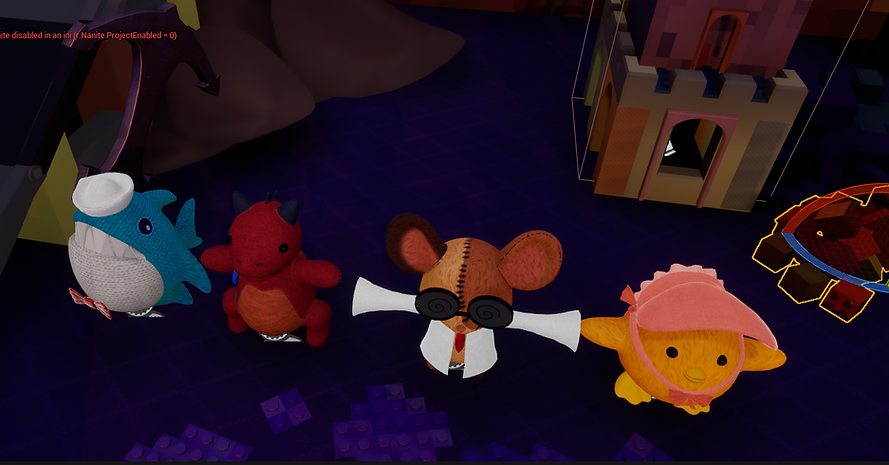

Concept Arts and The Final Looks:
I minimized the influence of lighting and inherent model volume as much as possible, allowing the result to more closely match the original concept art.


Procedural Content Generation
I developed a Lego generator tool in Houdini that converts 3D meshes into Lego brick assemblies, with segment-based color transfer. Additionally, I created master materials for toys to support flexible visual customization.

Several modular assets were processed in Houdini, where I used custom tools to procedurally bake them into LEGO-style brick geometry. After baking, I generated and refined the textures before integrating the assets into the scene.


Using Houdini, I simulated structural collisions for LEGO wall assets and generated four variations of LEGO ruins. These procedural results help introduce environmental variation while maintaining production efficiency. I also created 4 types of LEGO path and LEGO plate.


Instance Optimization:
Based on feedback from the engineering team, I used Unreal Engine 5’s Packed Level Actor to convert the LEGO castle assets into Instanced Static Meshes, improving rendering performance through batching.


